
After three years of strategic floundering, Teradata now understands that it has a leadership problem, and announces a CEO change. Victor Lund, who heads the audit committee on the board, takes the helm.
Speaking to investors, Lund noted in his opening remarks that he is too old to be the permanent CEO, denied that he is merely a caretaker, and said he plans to find a new CEO in 90 days.
Asked about strategic missteps, Lund pointed to the Aprimo purchase; a safe comment given previous announcements. Beyond that he said that Teradata must change its culture and move faster.
In other words, he has no idea what to do. But he’s gung-ho.
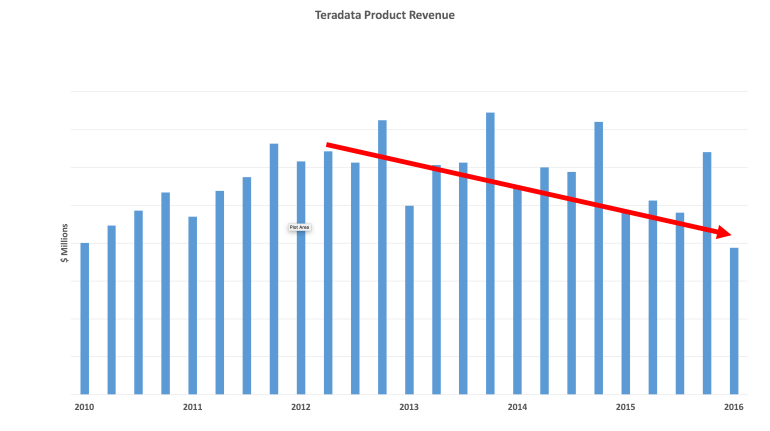
Teradata also reports a net loss of $46 million, and a 20% decline in product revenue. Product revenue drives consulting and maintenance revenue, and a decline that steep implies a failing business model. Consulting revenue was up 4%: maintenance revenue up 2%. Selling, general and administrative expenses, down 5%; research and development down by 10%.
CFO Steve Scheppmann announced a definitive agreement to sell the Marketing software business for $90 million, “below what we expected.” Teradata paid $525 million for Aprimo in 2011.
Steve, you’re supposed to buy low and sell high.
Demonstrating his keen insight into the data warehousing business, Scheppmann noted that buyers “are moving away from capex.” He noted that Q1 sales in the Americas were down because Teradata shuffled its sellers. (Asked about this in the previous investor call, Mike Keough denied that shuffling the sellers would impair sales.) Scheppmann also noted that some deals slipped to Q2, and expects some Q2 deals to slip into later quarters.
Lots of slippage going on.
Oliver Ratzesberger, president of Teradata Labs, painted a picture of Teradata everywhere: on-premises, in private cloud, and in public cloud. The fly in the ointment is that Teradata in AWS Marketplace is a single node version; Teradata without an MPP architecture is like a muscle car with a tiny engine. He noted that Teradata is accelerating plans to put an MPP version into the cloud, and now expects to do so by the end of this year, only five years after Oracle.
Ratzesberger also mentioned rebranding the Teradata architecture as IntelliFlex, and consulting-led solutions. He did not mention Aster. In fact, nobody mentioned Aster. Presumably, that old dog won’t hunt much longer.
Asked a slightly technical question, Ratzesberger rambled incoherently.
Lund, Scheppmann and Ratzesberger all spoke of the central role of consulting in leading Teradata out of the woods. If Teradata is serious about that, they’re going to have to go full open source, like Pivotal did last year. You can’t easily mix a strategic consulting business with a software business. Just ask IBM.





Leave a Reply